Showing posts with label air quality. Show all posts

Thursday, October 20, 2016

Spokane Valley Street Sweeping Starts Next Week

You're doing it wrong if this is how your parking
strip looks.
The annual fall street sweeping starts in Spokane Valley next week to remove, dirt, leaves and debris from roadways. Sweeping will take place weekdays between 7 a.m. and 5 p.m.

Street sweeping helps prevent clogging of stormwater drainage systems. If drains are clogged, pooled water can be dangerous to drivers. Street sweeping also helps prevent deterioration of roads due to standing water, and improves air quality by removing dust and dirt that gets into the air.

Valley officials ask you to please not sweep leaves  into the road. Also keep vehicles, trailers and portable basketball hoops out of the right of way while sweeping is underway.  The sweeping schedule is here.

Thursday, July 21, 2016

Spokane Reduced Carbon Monoxide Pollution

The Spokane Clean Air Agency has recently gotten federal approval for a limited plan to keep the air clean when it comes to carbon monoxide (CO) emissions, due to work done here to reduce CO pollution. Spokane has not violated federal standards for CO pollution since 1996, but at one time, the area had hundreds of violations a year.

Carbon monoxide in concentrated amounts is lethal. But it is also harmful in smaller amounts because it reduces the flow of oxygen to the body’s vital organs and tissues, according to the regional clean air agency.

The Spokesman-Review reports that the new plan may end mandatory vehicle emission testing by the end of 2019 at the earliest.

In 1976, Spokane saw 404 violations of the standard that limits CO to no more than 9 parts per million over eight hours. It was declared a “non-attainment” area and had to undertake a strict program to get the problem under control. Since then, CO levels have dropped steadily since; Spokane hasn’t seen a reading of 3 parts per million or higher since 2009.

Most of that reduction is due to improved fuel mileage, new vehicle pollution technology and blended fuels that reduce emissions.

The city of Spokane also synchronized stoplights and installed one-way streets to reduce vehicles idling at stoplights downtown. SRTC conducts air quality modeling that simulates the impact transportation projects and programs will have on air quality before they are constructed or implemented.

Spokane County was deemed by the federal Environmental Protection Agency to have attained the carbon monoxide standard in 2005, and was required to develop two 10-year maintenance plans. The second of those two plans was approved recently.


Tuesday, March 8, 2016

Milan Proposes Paying Commuters to Bike to Work

Smog is so bad in Milan some days that pedestrians wear
masks.
Around here, we talk a lot about what would get people to change their transportation behavior. For instance, if you drive to work alone now, what would convince you to maybe ride the bus or ride your bike to work everyday instead? Would more bike lanes or better sidewalks convince you? Buses that come more often or run later? Or would it come down to cold, hard cash to get you to change your way?

That's what officials in Milan think. According to Money, city officials there are proposing to pay people to commute via bicycle in order to lower smog levels. Like Spokane, Milan lies in a low valley, where air pollution can get trapped. Unlike Spokane, it is considered one of the most polluted cities in Europe.

This idea isn't the first step in cleaning up the air. City officials recently banned cars from the city center, offered discount tickets on public transit and added 50% more bike lanes and bike share stations around the city. 

Thursday, October 29, 2015

Spokane Clean Air Needs Citizen Representative

Transportation is a HUGE contributor to air pollution, whether from tailpipe emissions, dust from the sand used to make roads less slick in the winter, or dust from unpaved roads. That's why SRTC works very closely with the Spokane Regional Clean Air Agency.

Like many government agencies, Spokane Clean Air uses an Advisory Council or committee to provide transparency to their processes. They're now looking to fill a
 "Citizen Representative" position on its 9-member, volunteer Advisory Council.  Residents of Spokane County who are interested in air quality are encouraged to apply. 

To apply, submit a letter of interest, including relevant experience, by 4:30 p.m., on November 15, 2015, to:

Spokane Regional Clean Air Agency
Attn: Julie Oliver, Executive Director
3104 E. Augusta Avenue
Spokane, WA   99207

Members of the Advisory Council are appointed to 4-year terms by Spokane Clean Air's Board of Directors. Members meet on the fourth Thursday of each month, from 8-9 a.m., to advise and consult with Spokane Clean Air staff, Executive Director and Board of Directors, in their mission to protect, enhance and preserve Spokane County's air resources. Here's more info on the Council.

Wednesday, September 16, 2015

Air Pollution Could Kill 6.6 Million by 2050

Air contaminated with pollutants such as ozone and tiny particles could cause the premature death of about 6.6 million people a year by 2050 if nothing is done to improve air quality, the website Helpinus is reporting. 

A study published in the journal Nature today says that outdoor air pollution, a large amount of it caused by vehicles, already kills about 3.3 million people a year around the world. Air pollution deaths are most commonly from heart disease, strokes or the lung disease known as chronic obstructive pulmonary disease (COPD).  It is also linked to deaths from lung cancer and acute respiratory infections.

So what is SRTC doing to try to keep this from happening? We have an Air Quality Planner on staff to make sure that projects we help to fund and support don't cause air quality issues. For instance, adding a traffic light or a turn lane at new locations causes cars to idle and emit pollution. While this generally isn't a major problem, in areas that already have air quality problems, it can be an issue. For more information on local air quality, including problem areas and what our Air Quality Planner looks for, check out our web page on Air Quality.

Monday, February 23, 2015

The Many Benefits of Simply Sweeping the Streets

Spokane Valley is cleaning up it's streets. And a lot earlier than usual. Street sweeping crews are already out picking up sand and debris left from winter. This isn't just done to make roads look better, if left in place dirt and other items can clog stormwater drainage systems. 

Coupled with rain or runoff from the warmer weather, pooled water at the clogged drain not only poses a driving hazard, it accelerates deterioration of the street surface. It's also more cost-effective to sweep debris out of the roadway and away from drains rather than vacuuming accumulations out of the drywells.  

In addition, sweeping helps maintain air quality by removing excess dust and dirt that can get blown into the air by breezes and passing vehicles.  That's especially important to keeping air clean and minimizing health risks from breathing airborne particulates. 

 Pedestrians, bicyclists and those using wheeled mobility devices also benefit from increased stability due to less dirt and gravel on sidewalks and in bike lanes.

With that said, keep all those benefits in mind if you encounter slow-moving street sweeping vehicles along arterials over the next few weeks during daylight hours from 7 a.m. to  5 p.m.  Depending on the weather, sweeping in residential areas could begin as early as mid-March.  Regular sweeping of arterials will continue into fall along with sweeping of other areas as needed. 

Wednesday, April 2, 2014

Fresh Air Shipped To Air-Polluted Chinese City

Remember the movie "Space Balls" from the 80s? Probably not if you're any younger than me. There's a scene in it where the Mayor of Planet Druidia assures a caller that it's just a rumor that the planet is running out of clean, breathable air. He immediately gets off the phone and pulls out a can of Perri-Air that he cracks open and inhales.

Lowbrow comedy yes, but it wasn't so funny when
the same thing happened in a Chinese city that has particularly poor air quality. Bags of mountain air were shipped into Zhengzhou as part of a promotional gimmick to show oxygen-deprived city residents what they’re missing.

Zhengzhou is one of the country’s top 10 most-polluted cities. Here's more from the Wall Street Journal.

Monday, October 21, 2013

Health Organization Confirms Air Pollution Causes Cancer


Here's yet another reason to find ways to travel more efficiently- the International Agency for Research on Cancer (IARC) last week announced what's long been suspected; that air pollution causes lung cancer.

The IARC says it considers air pollution to be the most important environmental carcinogen, ahead of second-hand smoke. It includes gases and particulate matter that can be deposited deep in the lungs.

The main sources of pollution include transportation, power plants and industrial and agricultural emissions. Here's more from the Seattle PI.

Wednesday, August 21, 2013

Editorial Says It's Time To Get Rid Of Emissions Law

An editorial in the Spokesman-Review calls for an end to Washington's auto emissions testing program. The program technically expires at the end of 2019, but the article says the emissions testing law is no longer applicable, what with more efficient vehicles and cleaner fuel sources being produced. It even suggests the money funding the program might be better spent on other transportation improvements. Here's the Spokesman-Review article.
 

Monday, July 22, 2013

China Considering Expanding Restrictions On How Many Cars Can Be Sold


China already limits how many cars can be purchased in certain cities, and is considering expanding the restrictions to other cities as well. China is the biggest emitter of greenhouse gases, and is hoping to cut down on air pollution and traffic congestion by only allowing citizens to purchase vehicles through a lotterly system and by releasing a limited number of license plates.

China is the biggest car market in the world and opponents of limiting car purchases say cutting back on how many cars are sold could severely impact the economy.

Here's more on what's turning out to be a very sensitive topic in China.

Thursday, February 7, 2013

Congratulations To Ed's Premier Auto Body!

Congratulations to Spokane business Ed's Premier Auto Body; the recipient of the 2013 Clean Air Award. The award will be presented by Spokane Regional Clean Air Agency (Spokane Clean Air) today at Spokane County's "Way to Go" recognition event, starting at 11:30 a.m. at the Davenport Hotel.

SRTC's Executive Director Kevin Wallace is the keynote speaker for the event.
Ed's Premier Auto Body is being recognized for their comprehensive approach to auto body repair, resulting in increased efficiency and reduced air emissions. Emission reductions include toxic air pollutants and volatile organic compounds.

Ed's has worked to increase the efficiency of paint transfer, which saves paint and reduces emissions. Ed's sends it's painters to an expensive, comprehensive painter training program in Seattle to learn to paint better, therefore more efficiently.

Fifteen years ago, in an effort to reduce hazardous waste generated by the collision repair process, Ed's  started distilling dirty solvents and recapturing solvents from waste paints so that they can be reused. They currently distill about 10 gallons of dirty solvent per day, reducing hazardous wastes to less than 120 gallons per year. Without recycling the solvents, they would generate 2,600 gallons of hazardous waste per year, adding up to 36,000 gallons of solvents that have been recycled and reused in 15 years. Ed's Premier Auto Body also recycles all of the waste oil and waste antifreeze generated from repair jobs.
In addition, in 2012, Ed's upgraded their lighting, light fixtures and retrofitted their natural gas heating system as a result of an energy audit by their utility provider. Those upgrades have improved the building's efficiency, resulting in reduced electricity and natural gas use, which also reduces air pollution emissions.
The Clean Air Award is given annually to a company that demonstrates innovation, leadership, and a strong commitment to reducing air emissions.

Thursday, January 24, 2013

Two Local Schools Join No-Idle Zone Program

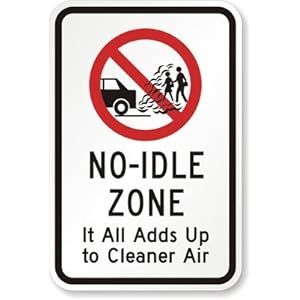
With the recent weather inversion and so many kids these days having asthma, a lot more people are thinking about the positive aspects of clean air. Two local schools have recently joined the 'No-Idle Zone' program.

Libby Center and Moran Prairie Elementary are now taking part in the program, which provides No-Idle Zone signs to post near trouble spots, which typically at schools are near student pick-up areas. The signs ask drivers to turn off their cars in those areas instead of letting them idle, and accompanying educational information is sent home to parents and activities are available to teach kids about air pollution in the classroom.

If you're interested in your child's school being in the program, check out Spokane Clean Air Agency's newsletter here. The No-Idle info is on the third page.


Friday, July 6, 2012

Summer Ozone Season Is Here

With temperatures expected to hit almost 100 degrees this weekend, the Spokane Clean Air Agency wants to warn you that 'summer ozone season' as arrived and encourage you to reduce emissions. To do this, they ask you to cut back on gas-powered activities, such as car trips and yard work that involves gas mowers or trimmers.
The hot days contribute to the formation of ground-level ozone, a harmful air pollutant and a key ingredient in smog. Ozone is formed when nitrogen oxides and volatile organic compounds (VOCs) react in the presence of sunlight. Pollutants from our daily activities "cook" in the sunshine and hot temperatures, forming ozone.
Ways to reduce emissions include:

• Reduce car trips by combining errands.
• Walk, bike, carpool or ride the bus to work.
• Purchase products and paints with a zero or low VOC content.
• Refuel your car in the evening when possible.
• Avoid overfilling your vehicle's gas tank or "topping off" your tank. Stopping at the first "click" reduces spills and the amount of gas vapors that escape into the air.
• Avoid using small gasoline-powered engines, such as lawn mowers and tractors, chain saws, power washers, air compressors, weed whackers, leaf blowers, etc.
• Keep tires inflated properly. When your tires are inflated correctly, your car drives more efficiently which improves your gas mileage and reduces the pollution entering the air.
• Store gasoline and other solvents in tightly closed containers in dark, cool places.
• Avoid using lighter fluid to start your charcoal barbecue. Lighter fluid has high VOC (Volatile Organic Compounds) content.

Here's more information on ozone and the damage it can cause, and a place where you can sign up to get alerts when air quality is poor.

Wednesday, November 9, 2011

Report Says Vehicle Exhaust Causes Brain Damage

Uh... not to cause a panic, but a new report out today says that vehicle exhaust isn't just bad for your respiratory system, but that it can also cause brain cancer and autism! The answer? This Wall Street Journal article suggests reducing traffic congestion.

Tuesday, September 13, 2011

Who Produces More Greenhouse Gas Emissions- Cities or Suburbs?

Thanks to Paul for sending me this one: Is there a correlation between urban density and carbon consumption? Earlier studies suggested that cities produce lower amounts of greenhouse gas emissions than suburbs do, but a brand new study says this may not be the case after all. Here's why, from The Infrastructurist.

About SRTC

SRTC is the federally designated Metropolitan Planning Organization (MPO) for Spokane County. Urbanized areas with populations exceeding 50,000 people are required to have an MPO. SRTC was formed to address the county's transportation planning needs. It provides coordination in planning between the public, cities, small towns, the county, the state, transit providers, and tribes.

SRTC offers services including transportation monitoring, transportation modeling, census information analysis, travel demand forecasting, historical traffic count analysis, geographic information systems, and trip generation rates.